

how to draw someone sitting on their knees
In this human body drawing tutorial, you lot'll learn basic human body outline drawing techniques. If you lot've skilful capturing energy in the previous tutorial, you'll have acquired a skilful feel for loose sketching of people. We're going to start giving structure to that feeling-based background past studying the body with a more scientific eye.
Let me say that it will accept many sessions to cover the wonders of the human body. Not only is it among the most sophisticated animal structures in nature, it is also 1 of those with the almost variations: few other species come in and so many shapes and colors. Nobody, therefore, should feel frustrated for having trouble cartoon people; it is an ambitious undertaking.
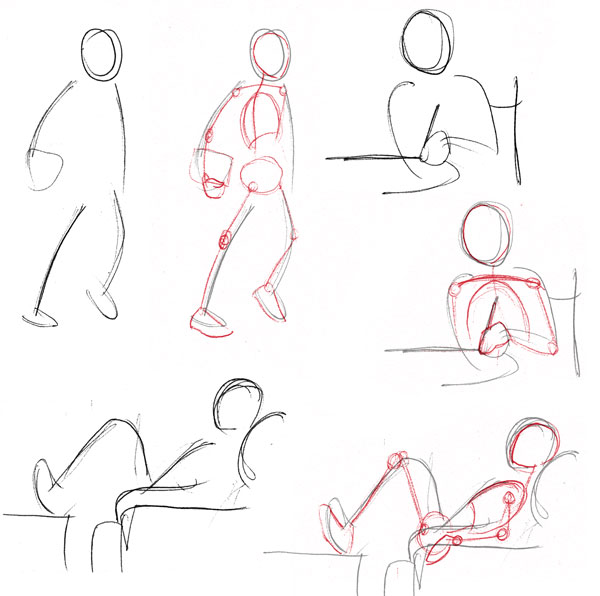
Nosotros're going to build up this skill from the footing up, in the same lodge as the drawing process, starting with a simplified body cartoon skeleton (the basic figure or stick figure), moving on to the volumes of musculus structure, and so finally the details of each part of the body and face up.
The showtime fundamental skills to acquire are human proportions drawing techniques. And we're going to be practicing with this basic effigy for a while to become familiar non only with the conventional "ideal proportions", but as well with the style they vary with gender, age, and even indigenous background.
If you're drawing digitally, perhaps you want your work to wait every bit if it's created with pencil and paper. If this is the case, may we recommend one of the many Photoshop brush sets available on GraphicRiver, including this Archetype Fine art Castor Pack.


What You Will Larn in This Man Body Drawing Tutorial
- How to describe the human body step by step
- Basic human body outline drawing
- Human contour cartoon techniques
- Human being body proportions drawing
- Trunk drawing exercise exercises
How to Draw a Body: The Bones Figure
Create Your Chart From Heads
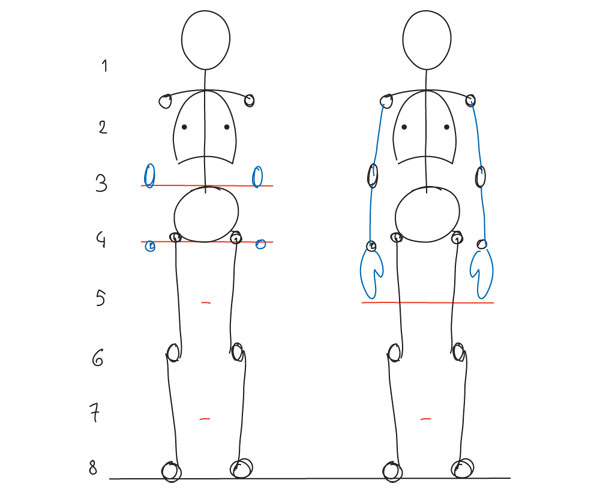
Let'southward begin with human drawing basics. A well-proportioned figure, regardless of variations due to gender and such, is defined by the alignment of the joints, which is changeless (that is, we perceive something odd if information technology does vary). This is our groundwork for proportions. Draw your own nautical chart with me as we go—it actually helps with learning the material.
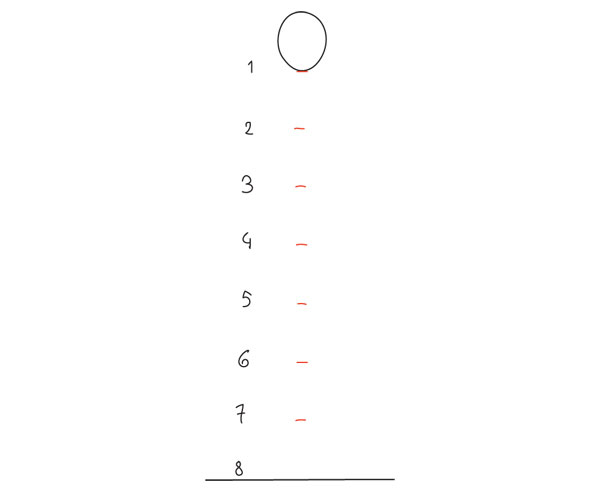
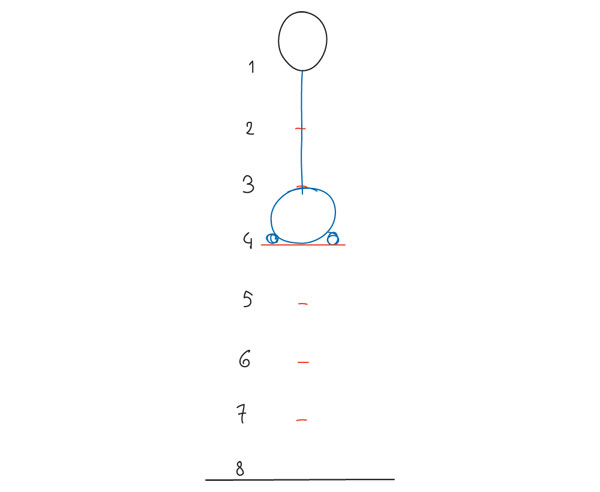
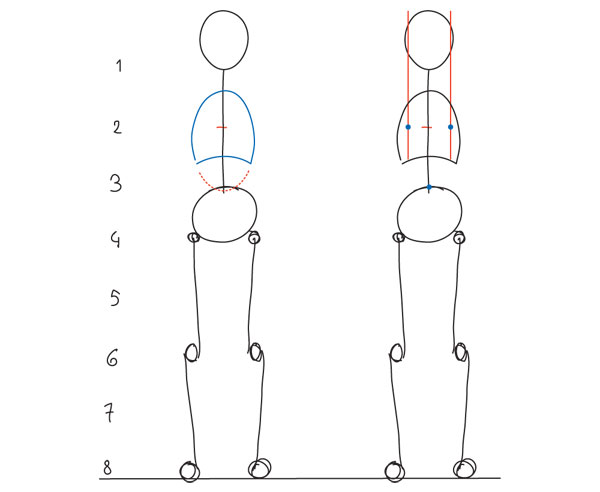
To acquire how to draw a trunk, we start with the head. Start by drawing an oval or egg shape (pointy end down) for a head, and mark down eight measurements, the last one beingness the ground.
The measurement (ideal male height = eight heads) was set downwards during the Renaissance as an idealization of the human being form. It's rather obvious that very few people are really eight heads tall (even Northern Europeans, who served equally the basis for this model, are closer to vii heads), but this is yet the best model to showtime with, every bit it makes it easier to grasp the alignments.
The Pelvis
Add the pelvic bone next, simplified as a flattened circle betwixt marks three and four, with the hip joints sitting on 4. Its width is roughly 1.5 to 2 caput-widths. You tin can now depict the spine connecting the head to this most important part of the body, its center of gravity and stability.
The Legs and Knees
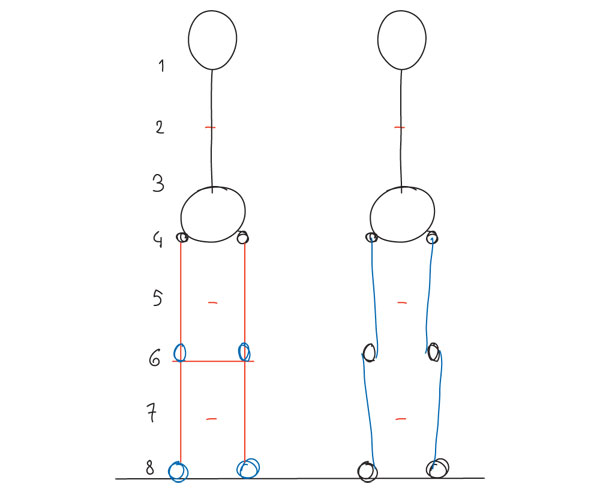
Let's assume this figure is standing with the feet vertically aligned with the hip joints. The genu joints sit on marking six, as that line corresponds to the bottom of the kneecaps.
When the leg is stretched out, the knee joint is placed on a straight line with the hip and ankle (left). But this straight line is virtual: to complete the leg, connect the hip joint to the within of the kneecap, and so again, the exterior of the knee to the inside of the ankle (right). This is a very simplified but accurate representation of the actual bone structure, and information technology helps in cartoon the natural look of the homo leg, which tapers in from the hip, then staggers out at the knee, and tapers in again. It likewise helps with placing the muscles at a later stage.
The Ribcage, Nipples, and Abdomen Button
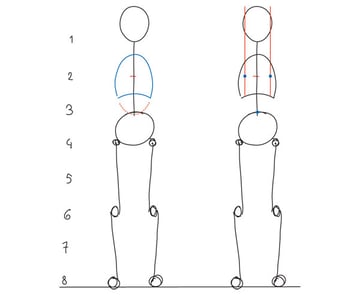
The ribcage-lungs grouping is the third important volume of the torso, after the head and the pelvis. Simplified, information technology is an oval that starts halfway between i and 2, downward to mark 3; simply it is all-time to chop off the lower part of it as shown here to imitate the actual rib cage, equally the empty role between the two volumes is important: it is soft and subject to change (flat belly, soft belly, wasp waist) and it is also where the well-nigh torsion and movement happens in the spine. It's good to be aware of that and non to attach the torso and pelvis together like ii blocks, as that would "block" your drawing'southward range of motion. The width of the oval is roughly the same as the pelvis for now.
Two more details hither: the nipples autumn on mark two, merely within the sides of the caput, and the belly button on mark 3.
The Shoulders
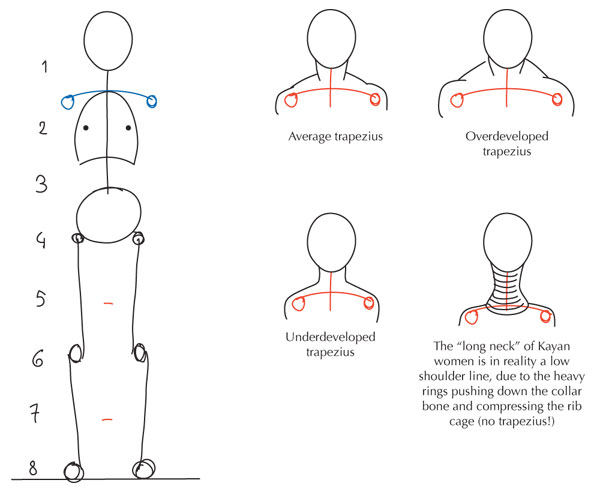
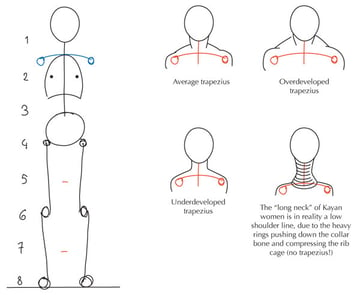
The shoulder line is well-nigh halfway between marks 1 and 2, with the shoulder width 2 to 3 caput-widths, but its apparent position can vary a great bargain. To begin with, it's slightly curved downwardly, but in tension the shoulders tense up and the curve can itself turn up and wait college. Furthermore, the trapezius muscle, which from the front appears to connect the shoulder with the cervix, is highly individual; if information technology'southward very muscular or carries much fatty, it can make the shoulder line look and then loftier there's no neck; inversely, an underdeveloped trapezius, often seen in very young women, gives the impression of a long cervix.
This brief digression into non-skeletal details is to ensure there's no confusion betwixt the bodily position of the shoulder line and its apparent placement in a fleshed-out body, some examples of which are shown below.
The Arm, Wrists, and Hands
Finally, the arms. The wrists are on marking 4, slightly below the hip joints, which sit down on information technology (you lot can test information technology out for yourself by continuing up and pressing your wrists against your hips). The fingers stop roughly at mid-thigh, which is marker 5. The elbows are a slightly complicated joint that we'll examine in detail later, just for now it's helpful to mark them as elongated ovals sitting on level 3.
We're done... almost. Before summing this up, let's extend those marks into lines and meet how this works in profile.
How to Depict a Body: The Basic Profile
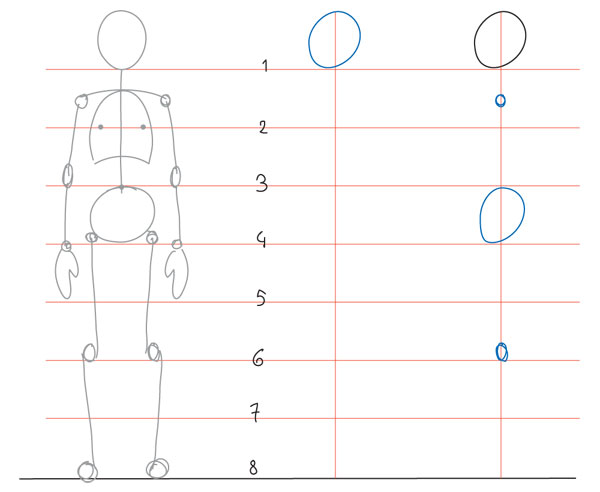
The next footstep in learning how to draw a body is the contour. Beginning by drawing the head again, the same egg shape simply with the end pointing diagonally downward, and drop a vertical line from the crown to the ground.
In an erect posture, you lot can place the pelvic bone (a narrower version of the head'due south egg), the shoulder, and the human knee roughly on this vertical line. They are on the same level as earlier: all the joints are, simply the others are not on the same airplane as these.
The Spine in Profile
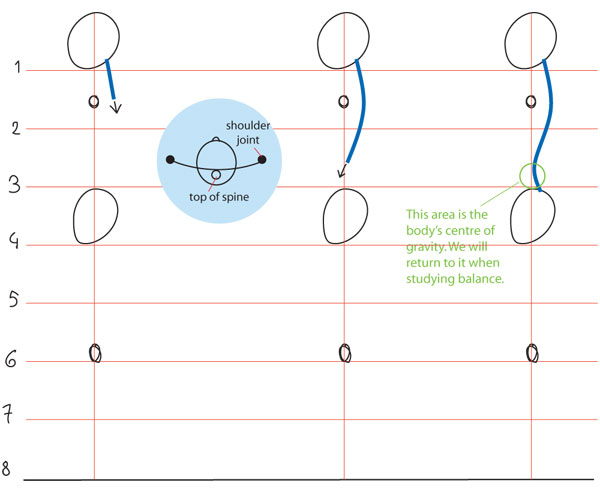
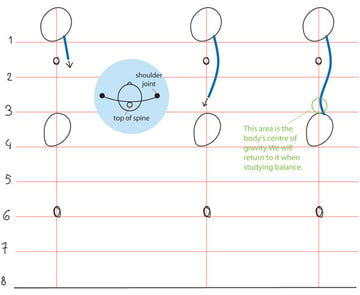
From the side, the spine is revealed as beingness shaped similar a flattened "Southward". From the base of the skull, it moves down and back till it reaches its furthest signal at the level of the shoulders (between the shoulder blades). Note the shoulder joints are alee of the spine! This is because, again, the shoulder "line" is in reality an arc: the medallion shows a acme view of it.
The spine then comes dorsum forward, and peaks again (inward) a little in a higher place the pelvis (the small of the back, which varies in depth and can brand for an arched back). Finally information technology changes direction once more briefly and ends in the coccyx or tailbone.
The Ribcage and Legs in Contour
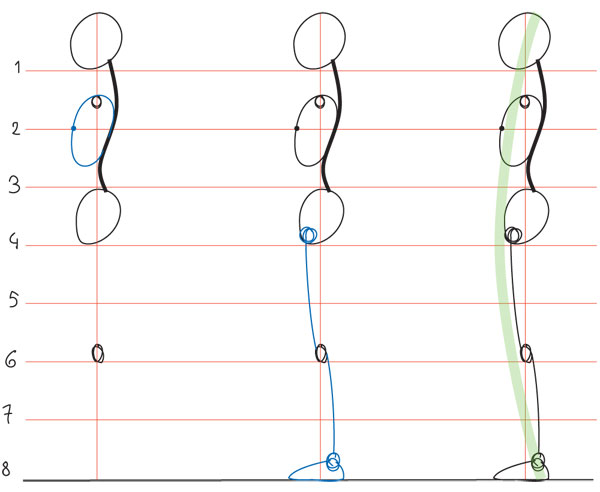
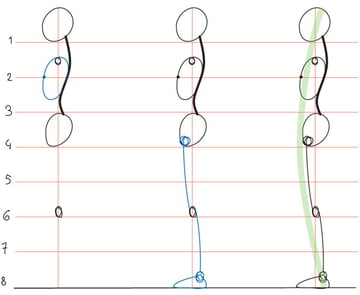
The ribcage is closely attached to the spine, and, in a reasonably fit body standing erect, the breast is naturally pushed forward.
The hip joint is ahead of our vertical axis, and this is balanced by the talocrural joint being a bit behind it. Then our hip-knee-ankle line is slanted backward, and staggered again: from the hip joint to the front of the knee joint, and from the dorsum of the human knee joint to the ankle.
The overall effect of this posture is a visual arc from head to chest to feet (in light-green), and when information technology's flattened or reversed, we perceive an uncertainty or slouch in the posture.
The Arms in Profile
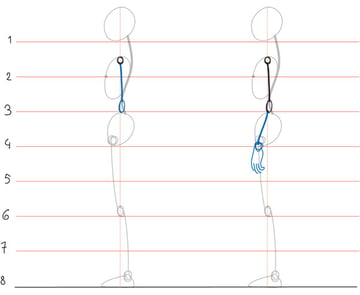
Finally, the arms. The upper arm falls fairly direct from the shoulder, then the elbow can be aligned with the latter (or fall slightly backward). Merely the arm is never fully stretched when at remainder, and so the forearm is not vertical: the arm is slightly bent, and the wrist falls forrad, right over the hip os. (Also, when the mitt is relaxed, the fingers gyre a petty, every bit shown here).
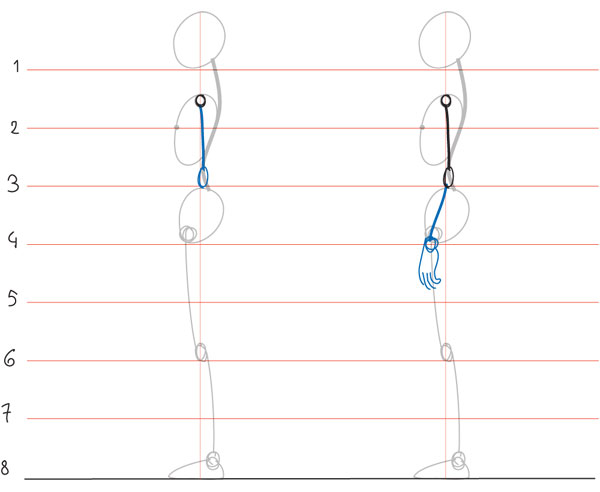
How to Depict a Torso: Summary
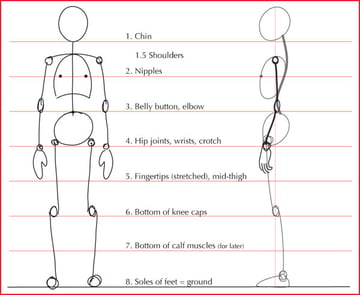
This completes the basic, undifferentiated human being proportions drawing tutorial. Hither'southward a diagram to sum up all the human body outline drawing techniques we reviewed:
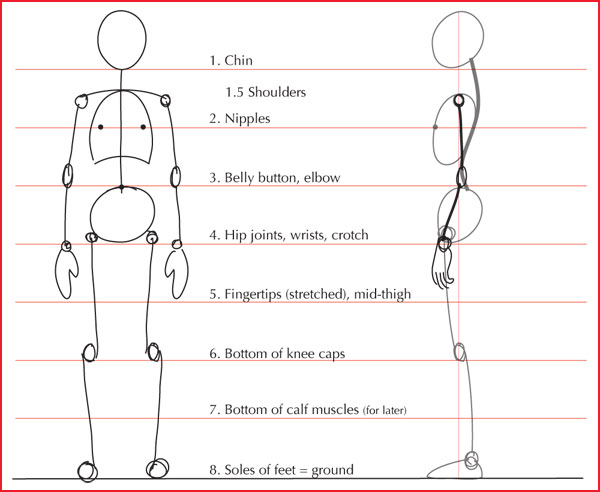
Human Body Proportions Cartoon Reminders
The following human proportions drawings are a few useful visual reminders based on the body. They come in handy when the body is non continuing upright.
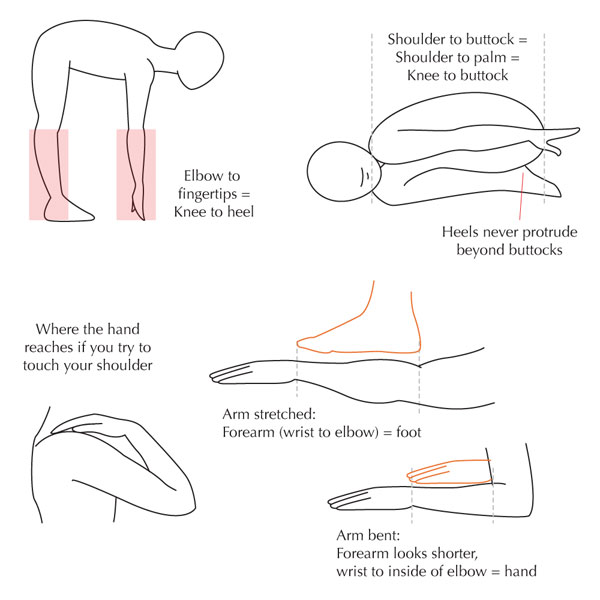
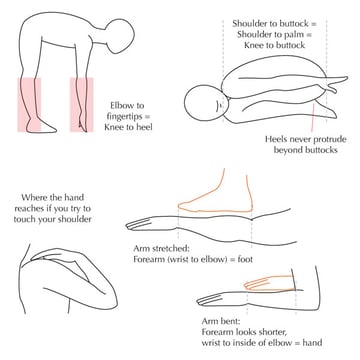
Body Drawing Practice Exercises
Nosotros've covered a lot of material in this body beefcake cartoon tutorial. Now is a practiced time to suspension the studying and familiarize yourself with this basic effigy and the principles of drawing human trunk proportions. Then, we'll move on to the differences between male and female person structures (and others). For example, yous can integrate this new cognition into your daily homo drawing sketching practice past overlaying a quick energy sketch with this correctly proportioned basic figure.
Human Proportions Cartoon Tips
I consistently beginning with the head, only it doesn't actually matter what function of the body yous start cartoon, if yous're comfortable and get a adept event. If you're unsure or are having a hard fourth dimension, then I suggest trying with the head first.
Go used to drawing this basic figure with a lite hand, since the finished body will exist built up over it. Traditionally, the terminal lines are inked and the guidelines and then erased (hence the importance of a light manus), but even when I'm sketching with a ballpoint pen with the intent of inking on a dissimilar sheet by transparency, keeping a light manus ensures I can see what I'thousand doing.
Discover More than Awesome Human Cartoon Tutorials
I hope you've enjoyed this tutorial nearly how to depict the human being body step by pace. If you lot want to learn even more than, nosotros've got this great learning guide: Human Beefcake Fundamentals. At that place you'll discover detailed homo cartoon tutorials and resources like these:
Editorial Notation: This post has been updated with contributions from Maria Villanueva. Maria is a staff writer with Envato Tuts+.

Source: https://design.tutsplus.com/articles/human-anatomy-fundamentals-basic-body-proportions--vector-18254
Posted by: werneralwyet.blogspot.com
0 Response to "how to draw someone sitting on their knees"
Post a Comment