

Where Can I Find An Artist To Draw A Portrait
Portrait painting techniques using photography.
At that place are many ways to paint a portrait. Many portrait painting techniques. Everyone has their own method, and all are valid. At that place has always been discussion about whether a portrait has to be made from real life or from photography. I will not give you an reply on that 1; if a painting is good and so the question need not come up upwards. I encourage observational written report equally much equally possible. In my stance, good drawing skills and knowledge of anatomy, are of the utmost importance.
Click here to see long tutorial videos.
Here I volition explain my portrait painting techniques when I piece of work from photography.
Photography.
Painting a portrait from photography has advantages and disadvantages. One of the major pitfalls is the danger of paying to much attention to the details. Likeness does not depend on the details but on large volumes. Remember that old school photo. You know perfectly well who is who, although the faces are no bigger than a quarter of an inch. Often too much particular has a devastating upshot on a portrait. Continue it simple and be bold with what y'all say. An advantage of working with photos, is that you just cull the shot you like about out of a series. Earlier you offset, it is important to pay corking attention to the photography session, and also to the printing.
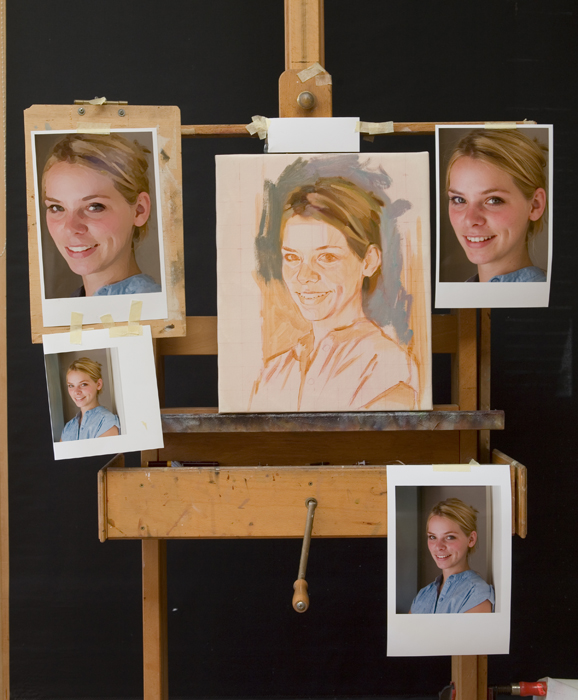
The first image shows several copies of the face effectually my canvas on my easel. The two large photos are the same size every bit the portrait on the sheet. The left is slightly unfocused to avoid distraction from details. Using this photo I encounter the unproblematic shapes more conspicuously. I have printed the smaller pictures in a lighter and a darker version.
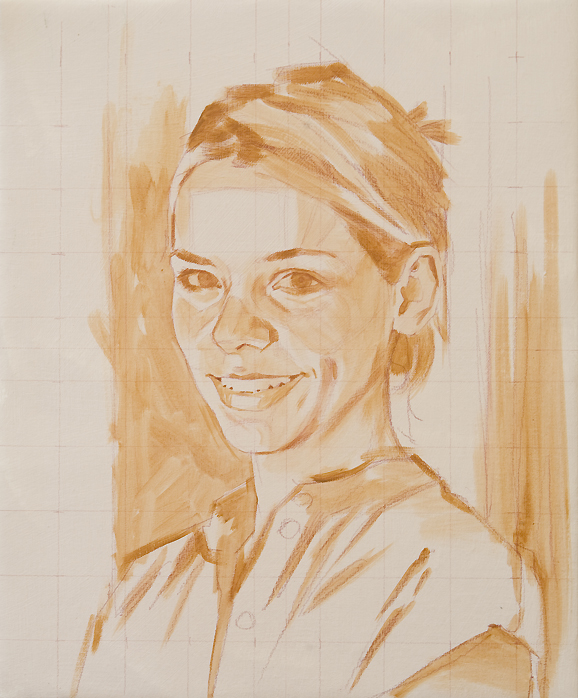
Preparation.
On the easel is the stretched canvas. I've transferred the image by using a grid distribution on the photograph also as on the canvas. I utilize ruby crayon. The black graphite of a normal pencil will always shows through all layers of oil paint. Here I fixed the cartoon with a very thin layer of shellac. Sometimes I utilise a thin coating of an alkyd medium. On top, in acrylic I paint an underpainting in raw sienna. If I get lost I always can remove a layer of oil to come across the basic drawing and underpainting.
Painting.
The actual painting of the portrait is about to begin. I start the day early past setting up my palette, which is washed with great care. I mix the peel colors and e'er use a test strip to bank check the mixture. Before I start painting, I rub the sheet with a neutral oil medium. So the linen is semi- saturated and the canvas "receives" the pigment from my brush more than easily.
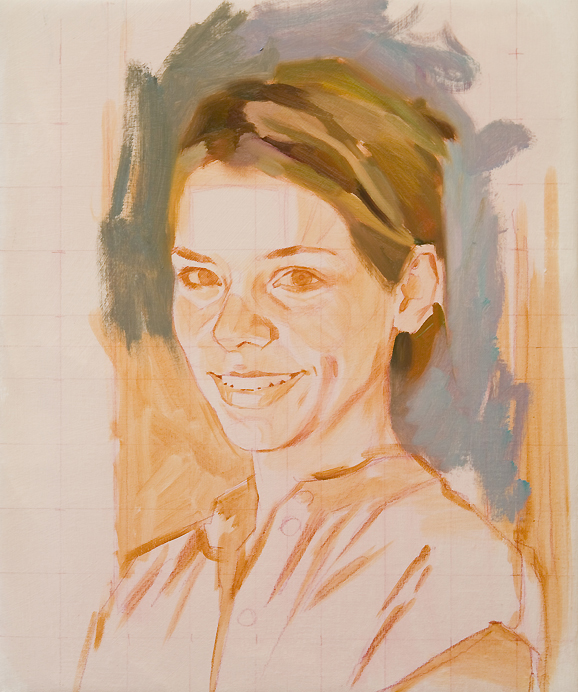
Get-go the hair.
I pigment the hair in simple, large planes using dissimilar hues. I don´t simplify the hues by using eye ochre mixed with brown for the darker areas, and white for the lighter ones. In the darkest tones there is crimson, veridian, sienna and cadmium orangish. In the lighter parts of the hair I´ve used cadium red light, permanent green low-cal, viridian, yellow ochre and white. The lightest colour in the hair is a mixture of ultramarine, crimson and white that I've prepared previously. This mauvish tint is great to brand light areas in blond hair without the risk of progressing to scarlet, yellowish or bluish.
From night to light.
Earlier I start with the face I paint the groundwork also in large simple planes. Hither I dilute the paint with a few drops of citrus turpentine. Ordinary white spirit also works well. I pay particular attention to the hairline. I don´t want to be sharp. The edges must be soft where the hair touches the skin.
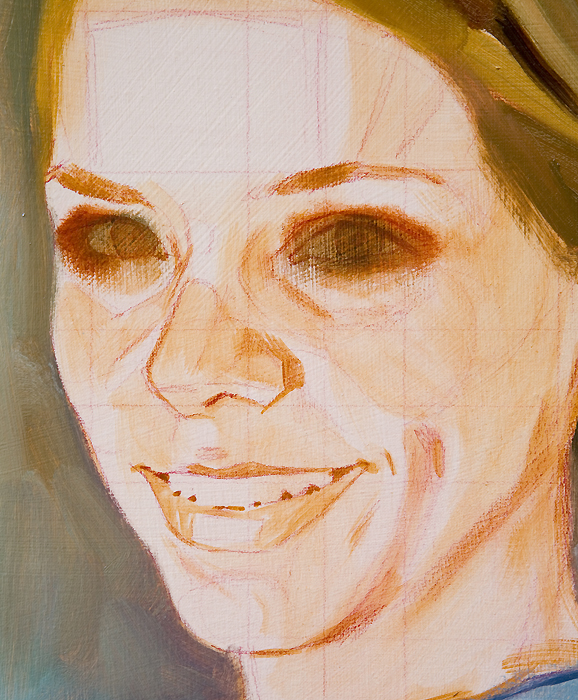
Get-go I give the optics a special handling. I paint a transparent layer of sienna and burnt umber. I smudge the paint with my finger so that I can still see the underdrawing. This creates a perfect base to continue later on.
And so I paint the rima oris in unproblematic schematic planes. Cadmium crimson, venetian red, white and ultramarine bluish are used here. I show the teeth every bit a continuous curved surface. I utilize my pre-mixed neutral gray light with some ultramarine bluish and cerise.
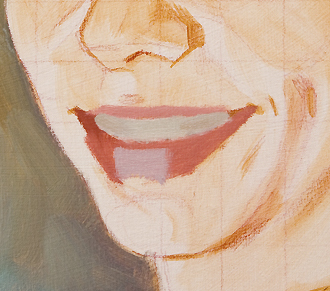
I always start with the shadows, then the halftones, then the lights. For the flesh I mix cadmium red calorie-free, white and ochre. Cerulean blue or permanent yellow-green tones are used for cooler or warmer tones. I'1000 nonetheless avoiding whatsoever details!
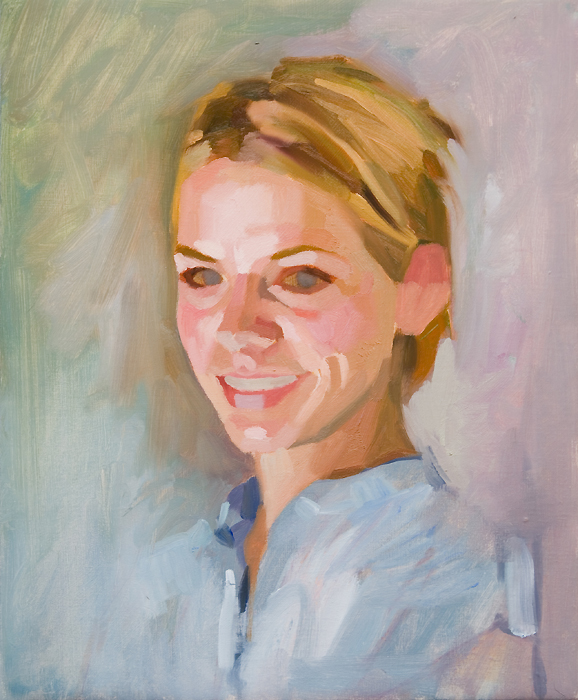
Keep a distance.
The portrait is in the kickoff phase and I take to go away. I walk off and take a loving cup of coffee or something. It is important to go out the easel. The longer I expect at my sheet the less I can judge what I have painted. Having a coffee is one trick, but at that place are more. In my studio I have a mirror in which I can see both the painting and the photo at the aforementioned fourth dimension. I clothing glasses. I accept them off and come across everything blurred. This is particulary good to get a perfect overall look at the residual of color and emphasis.
Now I simply accept my fourth dimension to assess everything. I retrace the portrait again from night to low-cal and finally put in some details. And so I finish the eyes and paint that small highlight in the pupil. Where necessary I alloy surfaces together sometimes with a separate tone in an intermediate colour. Looking at the cheeks, where the transition is important and can be subtle, I make sure that the curves are in the right place.
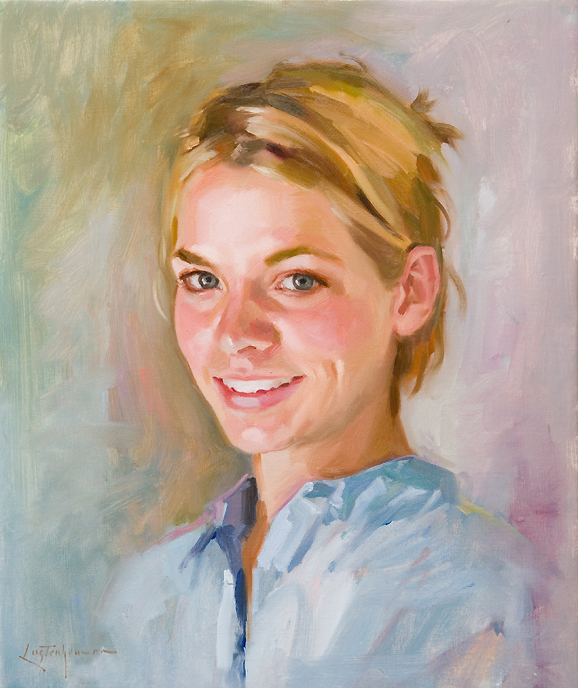
There is a sure risk of overblending the portrait in this phase. I paint the separation between the upper teeth and lower lip. I do not make individual teeth, only make sure the curve provides sufficient suggestion of teeth.
Finally, on the moisture background I pigment some brush strokes for locks of hair.
There are many portrait painting techniques as I said. Not always I follow this method. Fifty-fifty I change from time to time.

Source: https://paintingportraittips.com/homepage-old/portrait-painting-techniques/
Posted by: werneralwyet.blogspot.com
0 Response to "Where Can I Find An Artist To Draw A Portrait"
Post a Comment